It was Cinco de Mayo. A day I usually celebrate with tacos and Margaritas but not this time. Today, the big deal was that I got the first look at my back. The nurse changed the bandages, and Leslie took a photo with my phone. The incision was about 12 inches long. It started at the top of my back about the same height as my shoulders and went down to the middle of my back, centered between my shoulder blades. I had had my share of skinned knees and minor procedures to remove benign skin cancers and blemishes, but this was serious shit.
Everyone who saw it said it “looked beautiful. Very clean.”
To me it looked angry and horrible. The neurosurgeon said the scar would be minimal. I couldn’t imagine that. It was so long. He said the angry red/purple color was the glue they used on the top layer. The stitches were underneath the skin. There were two layers of internal stitches. One that stitched together the muscle and the other that stitched together the lower layers of skin. The glue was the last layer of protection that kept everything intact. The stitches would dissolve, and the glue would eventually wash off when I started showering without the bandage.
An added bonus was that I also had a tube stuck into my left shoulder that connected to a suction cup that drained the blood from the surgery site. It was Frankenstein-creepy the way a tube was stitched into my back. The drain container had to come with me wherever I went. The nurses drained the blood and measured it every day. The more mobile I became, the more I hated that thing. Eventually we named it Urakov, after my neurosurgeon. It was a reminder that despite the inconvenience of having it, it was instrumental in saving my life.
Dr. Urakov would visit every day at different times. I later found out that he did his rounds in between surgeries and teaching. He chatted with me and then looked at the drain. He didn’t even hold it in his hands. He knew what he was looking for from afar. I was always happy to see him even when I wasn’t happy. I saw him as a symbol of hope. Yet as nice as he was and as pleasant as he was to talk to, he was all business. He wouldn’t budge on the pain meds or the time the drain stayed attached to me. Each day, I greeted him hopefully. I held up the drain, asking if it could be detached, and every day he stood at the foot of my bed, arms folded and said, “One more day. It’s not the right color.”
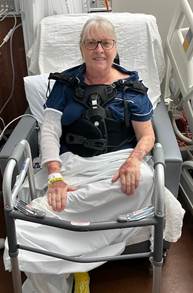
Still, as days in the hospital went, this was a decent day. I was stuck with Urakov (the drain) at least one more day, but I had the catheter out. I had the back brace and the walker. I was able to move around more and getting better at it. The next order of business was to get a shower and wash my hair. I also had to ditch that hospital gown! It made me feel worse than I was. Well, emotionally, anyway.
Throughout my stay, I refused sponge baths. They were too much of an invasion of my privacy. If anyone was going to wipe me down, it would have been Leslie, and I would rather have died than leave him with that memory. I was resigned to be dirty and waited to shower on my own.
Now that I was pseudo-mobile, I decided it was time. I didn’t ask for permission. I refused to be denied. I just asked Leslie to help me get set up. I wore the brace over the gown and used the walker to get to the bathroom. The bathroom was handicapped accessible so there were handrails everywhere. There also was a portable medical shower chair already in the shower.
Leslie had consulted with the nurse to learn how to tape up my back with plastic so the dressing wouldn’t get wet. It was like a 12” x 12” see-through, waterproof plastic sheet that adhered at every side. It felt weird every time I had to get taped up, but nothing was going to spoil my mood. I was taking my first shower in five days!
Leslie had raised two boys, so he hadn’t had any practice washing a woman’s hair. But now was his chance to learn. I will add that by the time I no longer needed his help to shower, he had gotten really good at washing my hair. He could have opened his own salon.
Here’s what my first shower was like. I had the vest on and made my way with the walker into the bathroom. The bathroom was a decent size, but with the rails that guarded the toilet and navigating with the walker, it was a tight squeeze for two people. Every move had to be choreographed. We started in the shower. The shower head was attached to the back wall. We placed the seat toward the front of the shower. The plan was for Leslie to be behind me with the shower head and direct him with it while I cleaned myself. We lined the seat with the pre-soaked Hibiclens wipes so I wouldn’t have to sit directly on the seat. It was like putting toilet paper down before sitting in a public restroom. Gross! We placed the shampoo and conditioner on the rail next to the seat so I could reach it. Now we were ready to begin.
We fit the walker around the sink. We lined the floor with towels so I wouldn’t slip. Slipping was the major fear for both of us. Leslie helped me take off the back brace and balanced it on top of the sink. I took off the gown and happily tossed it underhand onto the floor under the sink. I slowly made my way around the seat to the front of the shower and carefully sat down. Leslie was behind me for support. He took the showerhead off the wall, held it down and turned on the water. He checked the temperature then handed it to me. The warm water was glorious! I soaped up and rinsed. I wet my hair and handed him the shampoo. He washed it and I rinsed.
Leslie had to take care of my hair because I couldn’t reach my arms up very well. It pulled the incision on my back and hurt. The muscles on my back were also very sore. Plus, I had Urakov, the drain, that I had to hold in one hand. The tube wasn’t long enough to lay on the floor and when it slipped it would pull on the stitches, so I only had one hand to wash with. The whole process was very slow and methodical. After I rinsed my hair, I handed Leslie the conditioner. As he massaged it in, I started to feel human again. My first shower took a long time. We took every movement very slowly. We both were deathly afraid of me twisting or bending in any way so every movement was well thought out, discussed and intentional.
Finally, I was clean! My hair was washed. It felt great. And the best part? I put on my own clothes. Fuck that dreadful, ugly, ill-fitting gown with the back ass-side opened. I was almost a whole person again.
We reversed the process of getting into the bathroom to get out. First, I put on clothes, then we fastened the brace and then I stepped into the center of the walker. Leslie picked up the towels on the floor and I steered myself out.
However, I still had to dry my hair. First, we had to find a place to put Urakov, the drain, so at least I could attempt to use both hands. We discovered that it fit tucked into front of the brace. It was secure there. But I still had trouble raising my arms to reach my head to comb my hair and then blow dry it. The first time was clumsy, painful and I didn’t dry it completely. But still, I was clean! That was the main thing. And whatever hardship I had to overcome to be clean I would do it repeatedly every day. Feeling human was an attitude changer.
Now that I was clean and pseudo-mobile, I started sitting in the chair more with the brace of course, my constant companion. At least it was much smaller than the other. It closed at the waist and had front and back support where I needed it. The point of it was to prevent me from the three no-nos of post-spine surgery. No bending, lifting or twisting, also known by the BLT acronym to remember.
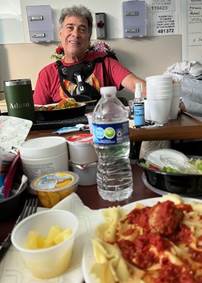
That night, Leslie and I had a very civilized dinner. It was hospital food, but it wasn’t awful. We wheeled both stands that hover over the bed face to face and it felt like we were across from each other at a restaurant. We had pasta and meatballs with a garden salad. Not too bad for a post-op day five.
Leslie had been on the phone with my sister Stacey all night, hatching a plan to get me back to the States. Ironically, we took this cruise specifically because we did not want the hassle of having to fly anywhere. Flying used to be fun. Glamourous even. Not anymore. Now it’s awful, cramped, unfriendly and a big fat pain in the ass. So, we chose this cruise even though I had been to three of the four ports and Mexico many times, starting when I was 16 with my Spanish class. But it was an easy drive to Port Everglades from our house to board the ship.
We called our families as soon as we realized just how badly I was hurt and how royally we were screwed. All of our kids were shocked, scared and worried. We promised to update them as soon as we knew something. That’s when my sister sprung into action. In my dedication, I mentioned that my sister knows a lot of people. She has always had a lot of friends. Lifelong friends. Friends in every industry she had ever worked. Friends in high places who know others in high places who get things done with just a phone call. She also had an incredible soft spot in her heart for nonprofit organizations. All of her work almost always involved a benefit and/or donations to one charity or another. I can say for certain that this was the one and only time that she ever called in every one of her favors.
It took her 31 consecutive hours. She arranged a private plane to pick me up at Cozumel International Airport to fly me to Fort Lauderdale International Airport where an ambulance waited to drive me to Miami to the Ryder Trauma Center at Jackson Memorial Hospital for emergency spinal surgery with world renowned neurosurgeon Dr. Timur Urakov.
Poof! Mind blown.
Meanwhile Leslie was the liaison with the Cozumel hospital, the plane and Jackson Memorial, coordinating everything having to do with medical records, scans, and the ambulance to take me from the hospital to the airport in Cozumel. He paid all the bills, secured payment for the private plane, dealt with the passports, the Mexican government and schlepped the suitcases. I watched and listened to each new development. I was in awe of what both she and he had done. Grateful, blessed and very angry. I was seriously injured, tethered to the bed. I was paralyzed with fear of paralysis and pissed off that this had happened to me. Meanwhile Leslie still had a compression fracture in his spine that was going untreated because I needed so much care and his full attention.
While we waited to hear about the flight out, Leslie attended to the suitcases. In their haste, the cabin stewards just threw all our belongings into the suitcases. No folding. No order. It looked like they just wanted to get us out of there as fast as possible. So, Leslie started organizing the contents. Knowing I was going to the hospital in Miami, he packed one of the small bags for me to take with me. Then he arranged for his son to meet us in Fort Lauderdale to take the rest of the bags home. He packed and rearranged for hours. Bending and lifting the heavy bags till his back was screaming for him to stop.
The plane and volunteer staff were ready to come for me in the afternoon, but the Mexican government was holding up the plans. It took them six hours to finally give us the go-ahead to be released.
While we are waiting for clearance, I decide that I will be damned if I was going to leave the hospital naked in an ugly hospital gown to be somehow carried onto a plane with my ass hanging out the back of a gown. I asked Leslie to fish out some comfortable clothes. He refused. I started cursing at him. Every negative emotion I had, terror, fear, frustration, I unleased on him at that moment. Neither of us had much sleep. We were both in pain. Mine being treated with morphine. His untouched. Afraid of the known and unknown that I started to cry again. He finally acquiesced, but he was extremely alarmed that changing into clothes was going to further compromise my already dicey spine. As I started to dress, I realized I couldn’t do this alone. We had to thread the IV through my camisole and shirt. And then thread the catheter through the leg of my yoga pants. I begged him for help. He finally gave in, all the while protesting that I could hurt myself worse with this vanity. After we finally got it done, all there was to do was wait for the ambulance to arrive. At least I was presentable whenever the paramedics decided to arrive.
One important footnote here. Leslie refused to try to sleep. He even refused to rest. After several hours, he finally stopped packing and re-organizing suitcases, but he was exhausted. And, of course, still injured. Our entire world was truly on his shoulders. Our existence, 100 percent his responsibility. He was constantly stressed, worried and even when he would unintentionally doze off, someone needed his attention.
Our Western Caribbean Cruise getaway proved to be a trip we’d never forget…
And not in a good way.
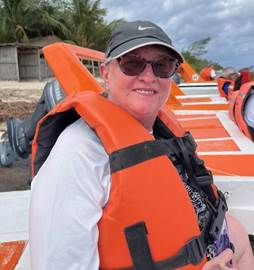
We left the ship early for a half-day shore excursion. The morning was overcast but it was not raining. It was a relief that the sun wasn’t beating down on us. We were going off-roading in a Polaris 4×4 then motorboating in a 14-foot, two-seater, 30-horsepower outboard engine followed by an authentic Mexican lunch on the beach in Cozumel.
We didn’t make it to lunch.
There were 18 of us on this shore excursion. All couples. The tour started with off-roading. Two couples were assigned to one Polaris. Halfway through the ride, off road, we swapped spots and took pictures. We went from being passengers in the back to a driver and navigator in the front. Off roading ended at a beach club where we were to go motorboating. I texted the off-roading photos to our friends Bo and Suzanne. I captioned them that we were “channeling Bo” by off roading on this trip. Bo drives his Jeep off roading in Mississippi whenever he can and has shared his muddied photos with us. We had never been off roading before, and we were so proud of ourselves for doing it.
At the beach club, the tour guides sat us down to watch a short video on how to use the throttle on our motorboat. Then we were assigned to a boat. Somehow, we ended up in the lead boat behind the tour guide. All the other boats were behind us, following in a line. The boat was small, only 14 feet. It was orange and white with a wooden bench seat. The bench was so low that we couldn’t tuck our legs under us. The bow of the boat narrowed to a point like a woman’s high-heeled stiletto. It wasn’t very comfortable. The only way to sit at all was to stretch our legs out in front of us and sit kind of sideways, angling our hips toward the center of the boat. The steering wheel and throttle were on the right side. My husband drove. I was a passenger on the left. There were two rope handles: one in front of me and one to my left.
The water was calm, but the ocean was crowded. There were two big 25-plus-passenger party boats speeding around in deeper water about 50 yards offshore. They turned the calm water rough, leaving big wakes as they passed by. We bobbed up and down as the waves rolled toward shore, waiting for our tour guide to give us the sign to throttle forward.
When we got the sign, my husband pushed the throttle forward and we started to speed up. At the exact same time the packed party speedboat’s wake hit us.
Our little boat hit the wave head on. It flew up in the air and crashed down hard on the water. We both heard a crack… It was my back.
“Are you ok?” he asked and stopped the boat.
“No. I can’t sit up,” I said. “Did you hear that crack?”
“Yes,” he said.
“I think something broke,” I said, my breath ragged. “Get me to a hospital,”
“Can you move your arms and legs?’ he asked. That was the first of many times I would be asked that question.
“Yes.” I said.
“Ok,” he said. “We’re going back.”
Leslie waved frantically to the tour guide ahead. I couldn’t straighten up. I sat hunched over on that bench with my head tilted down. I was trying to make sense of what had just happened to us. And figure out what was going to happen next.
I knew I was hurt. It was the kind of hurt you instinctively know could be life changing. I just kept holding onto the thought that I could still feel both my arms and legs. I could wiggle my fingers and toes. All I wanted to do was go back to the ship into that idyllic stateroom and order room service for the rest of the cruise.
My husband’s back hurt too. But he seemed to be able to move. One of the guides idled over to our boat and tied a rope to our boat while my husband continued to steer as they towed us back to shore.
It seemed like it took an eternity. All I could do was listen to the hum of the engine as we slowly made our way back to shore. I had to keep my head down. It hurt to lift it up. When we got to the shore, I was told that I had to get myself out of the little boat and walk up the beach on my own. I had no idea how to do that. Should I even be moving? Will I hurt myself even more?
It quickly became abundantly clear that no one was going to get me out of the boat. I was frozen. Afraid to move. Terrified that I would hear a snap and crumble to the ground, paralyzed, losing the feeling in my limbs. Slowly, gingerly and very painfully, I hoisted myself up with my arms off the bench seat and slid onto the top of the back of the boat. I had to slowly swing my legs around over the side of the boat and slide down into shallow water. Then I had to walk up the sandy hilly shore toward the beach club. To this day, I have no idea how I did that. But I did it. As I got to the entrance to the beach club, someone brought out a white plastic chair for me to sit on while they called an ambulance.
Thirty minutes later, three paramedics introduced themselves. They apologized for their poor English as I tried in my very rusty Spanish to explain what had happened and where I was hurt. They placed a gurney at my feet.
We all agreed I needed to get to the hospital, but how was I going to get out of this flimsy chair and onto the gurney? Again, not knowing exactly what we heard crack or how bad it was, I feared any kind of big movement would do more damage to myself. The chance of being paralyzed never left my mind. My heart raced while the pain in my back was excruciating. I didn’t want anyone to help me for fear that they’d jerk me somehow. I took a deep breath and pushed myself out of the flimsy chair, again using my arms. Standing hunched over, I steadied myself. Then slowly turned toward the gurney, shuffling my feet in the sand. I lowered myself into a sitting position on the gurney and the paramedic adjusted my legs.
Throughout this entire experience, the terror I felt would be expressed in varying emotions. There I was on a gurney in the sand on the beach in Cozumel. I was supposed to be enjoying myself on vacation at a Mexican beach club luncheon. Instead, I was on a gurney, trying to figure out how they were going to get me to the ambulance parked outside the beach club. Every little bump hurt! So, how did they do it? Seven men lifted me and the heavy metal gurney onto their shoulders like the Queen of Sheba and walked up the beach to where the ambulance waited. I am pretty sure that’s not a sight one usually sees on the seashore. I thought it was really funny and started laughing. But that hurt too. Then they put the gurney down on the asphalt to slide me into the ambulance. I screamed in pain.
Once I was in the ambulance, the paramedic told me she could give me something for the pain. About time! But to reach my upper arm, she had to cut the sleeve of the white swim shirt I was wearing that protected me from the sun. She had no idea how much time I spent trying to find that swim shirt, in the right color and size to fit under my bathing suit. I even had it tailored because the sleeves were too long. At that point, it didn’t even matter. Nothing mattered except to stop the excruciating pain I was feeling. Not to mention the growing anxiety I had, knowing I was headed to a Mexican hospital for emergency care.
Even after the shot of Toradol the medic gave me, every bump the ambulance hit was painful.
“Despacio!” Rita, the female paramedic, would shout every time she saw me wince.
The ride probably took 15 minutes. The meds kicked in quickly and I was more comfortable than I had been. That is until they had to move me from the ambulance into the hospital and change gurneys. I screamed. They gave me another shot in the arm that they called Mexican morphine. They said it was not the same as American morphine, but I never understood the difference. All I knew was that it worked.
After that shot, and still in the emergency room, I had a chance to settle down and found a relatively comfortable way to be still. It was the equivalent of lounging on a chaise though obviously not by any hotel pool.
The doctor saw us quickly and ordered X-rays. Mine was first. Still feeling the effects of the shot, the X-ray wasn’t terribly painful. They didn’t have to move me much. But the doctor didn’t like what he saw, so, he ordered a CT scan. By that time, the pain meds were wearing off. When they moved me from the gurney onto the table for the scan, I screamed so loud my husband heard me from his gurney in the emergency room. He was being examined now as well.
The CT scan showed something. They had to consult with another doctor they called a traumatologist. He ordered an MRI. Unbeknownst to me, the MRI cost $1,000. Before they went through with it, my husband had to approve the charge, which of course he did. Meanwhile, I got another shot of Mexican morphine. But when they moved me from the bed to the MRI table, I screamed out in pain again. Plus, the room was freezing cold. and I was still wet and sandy from the wave that hit the boat. To take the MRI, I had to lie flat on the scanner table. Flat was bad. Even with morphine, the pain was unbearable. I tried to find a position I could lie in that hurt less, but nothing worked. I couldn’t stay still. I had to keep adjusting my back to get some kind of relief. That MRI took an hour and twenty minutes! The morphine wore off and I was shivering from being in pain, wet and cold.
Finally, they returned me to the ER room with my husband. I got another shot of Mexican morphine, and I was finally stationary. One look over at Leslie and I knew something was very wrong. Leslie’s X-ray showed that he had a compression fracture of his L1 vertebrae. That’s the first vertebrae in his Lumbar spine. Up until that moment, I had no idea what that meant, but I knew it wasn’t good. Then the doctor came in to see me.
“You have a broken back,” he said.
“A what?” I said. “I walked up the beach after climbing out of that tiny boat and sat in a rickety plastic chair before the ambulance arrived. How could I have a broken back?”
“Fractured,” Leslie said. “Your spine was fractured. Bad translation.” Apparently, he knew before I did that this was the stuff nightmares are made of.
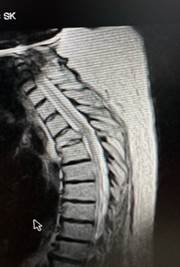
The doctor went on to explain that when the wave launched us into the air, we both landed on that hard bench seat with our spines. My fourth Thoracic vertebrae absorbed the impact and shattered. That was the cracking sound we both heard. I slowly learned that the nerves in the T-4 vertebrae are responsible for the upper chest and arms. It also monitored the gallbladder. An injury to the T4 spinal cord could cause paralysis from the chest down, which included not being able to control the bowel or bladder.[1] My worst fear!
This was what I was thinking about when the doctor showed us the MRI image and explained what happened.
The impact of the crushed T4 sent shrapnel into my spinal column. It did not pierce my spinal cord, which is why I still had feeling in my arms and legs. But as he continued to explain, any movement could change that.
That’s when it hit me. I was being admitted to a Mexican hospital because I had to be immobilized. I was not going back to the ship to order room service while I convalesced in our lovely mini suite with full bathroom and gorgeous sunset-laden balcony. We were not going to toast each other with Champagne and canapes on that sunset balcony. Our seven-day getaway cruise was over on day three. That’s when I started to cry. I cried. And cried. I cried those wailing cries of loss for the rest of the time I was in the ER until they wheeled me to a room.
Leslie, on the other hand, although hurt, was able to move around with somewhat manageable pain. He refused his hospital admission so that he could get back to the ship to get our luggage.
I got more Mexican morphine.
Then we got even worse news.
There was no spine doctor on Cozumel. It’s an island. The closest doctor was in Cancun, three hours away by plane. Then the other shoe dropped. I would not be able to fly home by commercial airline.
First of all, I wasn’t even thinking about having surgery in Mexico, assuming I needed surgery. But holy shit!
“What did it mean I can’t fly commercial?” I said. “How am I going to get home? How long am I going to be in pain? What are we going to do?”
An infinite number of questions flooded my brain. It was so surreal it was hard to take it all in. A few hours ago, I was on a fabulous cruise with the love of my life to get my mind off being unemployed. A wave hit us in a little boat on a shore excursion and I was stuck in a bed in a Mexican hospital afraid of being paralyzed from the chest down. WTF.
Fortunately, Leslie was way ahead of me absorbing this.
He contacted the cruise line. They sent a representative to meet us. In all the chaos, I don’t think I caught his name. And with all that was going on with me, Leslie handled all the details with this guy anyway. Between them, they arranged for our cabin to be packed up. Leslie went with the rep to retrieve our bags and met me back at the hospital. I was admitted and by the time he got back, I was in a room.
It was a very nice room. It was big. It easily fit two hospital beds. One part of the wall had a floor to ceiling window so we could see outside. There was a tropical mural painted on another wall with a porthole on a ship looking out over the water. Ironic, right? Just a few hours ago, I was on a real cruise ship looking out over the real ocean and now I’m looking at a mural on the wall of my hospital room of a porthole on a ship looking out over the water.
My lips were very dry, so I asked for some Chapstick. It took some charades between the two language barriers, but one of the attendants figured out what I was asking for and was kind enough to get me the Mexican brand from the gift shop. Labello. I still have it. It’s pretty good stuff.
I settled myself into my surroundings as best as I could when I realized that I was still wet and sandy. Then suddenly, it occurred to me that I had a new problem. I had to go to the bathroom. I guess with all that was happening to me, I didn’t realize I had to go. But now that it was quiet, I had to go badly.
I called the nurse to help me to the bathroom.
“Lo siento senora,” the nurse said. “I’m sorry ma’am, you can’t leave the bed.”
“Well, I have to go,” I said.
“You can try to use in a bed pan,” she said.
“Well, first of all, that’s gross,” I countered. “And secondly, I can’t lean on my back to prop myself up.”
“Otherwise, you will have to have a catheter,” she said.
“Whoa? A catheter? No way,” I said.
“Your spine is fractured,” she reminded me. “You can’t leave the bed.”
“Shit,” I said, feeling completely defeated.
I was defenseless. I had zero options. I was truly stuck and hated every second of it.
I was not comfortable being dependent; not being in control. And that was putting it mildly. I also don’t like my person or personal space invaded as both were about to happen to me in the most intimate way imaginable.
Fortunately, I still had my Louis Vuitton bag next to me. I slipped my hand in. Pulled out the little round pill case and secretly swallowed a Xanax. My savior. Those little pills would prove to be my most trusted source of solace.
The nurse hooked me up to an IV. Then I was catheterized. The realization of this situation hit me, and my mood plummeted. I started to cry again. It was another full-on body heaving, tears flowing, all out cry, complete with an accompanying level of screaming and cursing over this disaster of a situation I was in. The only positive I could find at that moment was that at least the pain meds I was getting through the IV had kicked in. I was in almost no pain. But, from all the Mexican morphine shots I had been given, the skin on my left upper left arm was deeply bruised in black and purple.
To be fair, I am very fair skinned. In general, I bruise like a peach if you looked at me wrong. But this was something I had never seen before. And it never really went away. It faded but you can still see the shadow of where it was.
Leslie finally arrived with our suitcases; two big and two smaller ones. In addition to getting dressed up for the specialty dinners and having a professional photographer take portraits of us every night, we also had a total of four shore excursions. They included horseback riding on the beach in Honduras and visiting ancient ruins in Tulum and Belize. Instead, of enjoying that and the Thermal Spa we both dreamed of using every day, I was propped up in my hospital bed, staring at all of our suitcases that lined the wall of my hospital room in Cozumel. I was in constant fear that if I moved in any way, my spinal cord would be pierced, and I would be paralyzed.
For a little background, my thoughts on being paralyzed are equivalent to those of Hillary Swanks’ character Maggie Fitzgerald in the movie Million Dollar Baby. When she woke up in the hospital and realized she was paralyzed from the neck down due to accidentally falling in the corner of the ring and breaking her neck on the stool, she bit her tongue hoping to bleed to death.
As day turned into night in my hospital room, I wanted a giant Margarita with a Cuervo floater, chips, guac and salsa. My stateroom would have been aglow with a golden sunset as we sailed away from Cozumel. The smells, the sounds and gentle rocking of the ocean from my 10th deck balcony would have been glorious. We would be getting dressed up again for our next fantastic dinner and photo shoot on Deck 6…
None of this happened.
And it wouldn’t happen again for a long time. But first, we had to figure out how to get off this island.





 The Reddy Life